






 Byadmin

What Is a Legal Calculator and What Is It Used For? A Plain-English Guide
Share your love
Let me guess. You’re sitting somewhere — maybe the kitchen table, maybe the parking lot of a lawyer’s office — and a single question is rattling around your head like a coin in a dryer: “How much is this actually going to cost me?”
Maybe it’s child support. Maybe it’s alimony. Maybe it’s how much a fender-bender settlement might land you, or how long you’ve got before some legal deadline slams shut. Whatever it is, you want a number. Not a lecture. Not a $400-an-hour consultation just to hear “it depends.” A number.
That, in a nutshell, is why the legal calculator exists.
I’ve spent a good chunk of time poking around these tools, and here’s my honest take: a legal calculator won’t replace your attorney, and it shouldn’t. But it will take some of the fog out of a stressful situation and hand you a starting point you can actually work with. In this guide, I’ll walk you through what a legal calculator is, the different types you’ll run into, who uses them, what they’re genuinely good for, and where they fall flat.
Grab a coffee. This one’s worth the read.
What Is a Legal Calculator, Really?
A legal calculator is an online tool that takes information you plug in — your income, your state, the number of kids, the type of accident, whatever the situation calls for — and spits out an estimate of a legal figure or outcome.
Think of it like a recipe. You bring the ingredients (the facts of your case), the calculator follows the formula (a law, a state guideline, a standard equation), and out comes a dish (your estimated number). The catch? It’s a sample dish. The real meal gets cooked in negotiation, mediation, or a courtroom — and a judge holds the final spoon.
Here’s the part people miss. A good legal calculator isn’t just a random number generator with a gavel emoji slapped on it. The solid ones are built around actual state formulas and statutory guidelines. A child support calculator, for example, often mirrors the official worksheet your state’s court uses. So while the result isn’t a guarantee, it’s also not a wild guess. It’s an educated, math-backed ballpark.
In short: a legal calculator turns a vague, anxiety-soaked “I have no idea” into a concrete “okay, roughly this.” And honestly? When you’re going through something hard, roughly this feels like a life raft.
How Does a Legal Calculator Actually Work?
Let’s pull back the curtain, because the magic is less mysterious than it looks.
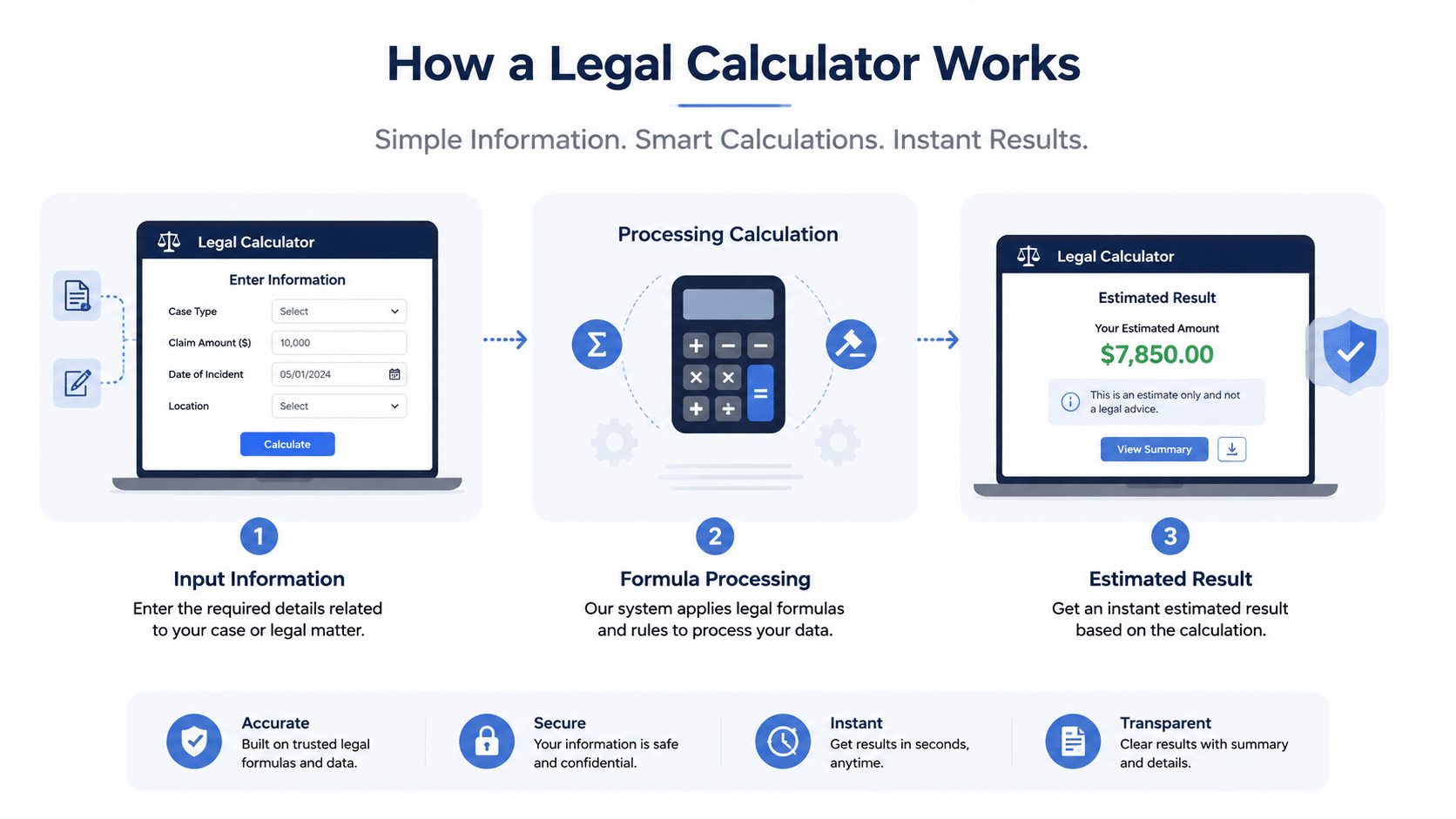
Every legal calculator runs on the same basic three-step rhythm:
- You enter information. This is your raw material — income, expenses, dates, state of residence, number of dependents, injury type, and so on. The more honest and accurate you are here, the better. Garbage in, garbage out. It’s not glamorous, but it’s the truth.
- The tool applies a formula. Behind the scenes, there’s a set of rules. Sometimes it’s a literal state-mandated equation (very common with child support). Sometimes it’s a widely accepted industry benchmark (common with personal injury estimates). The calculator does the math so you don’t have to graph anything by hand.
- You get an estimate. Out pops a number, a range, or a date. Many calculators also break down how they got there, which is the part I’d encourage you not to skip.
That last point matters. A trustworthy calculator shows its work. If a tool just flashes a big number and says “trust me,” be a little suspicious. The good ones explain the breakdown so you can sanity-check it — and so you can walk into your attorney’s office sounding like you did your homework. Because you did.

The Different Types of Legal Calculators (The Big List)
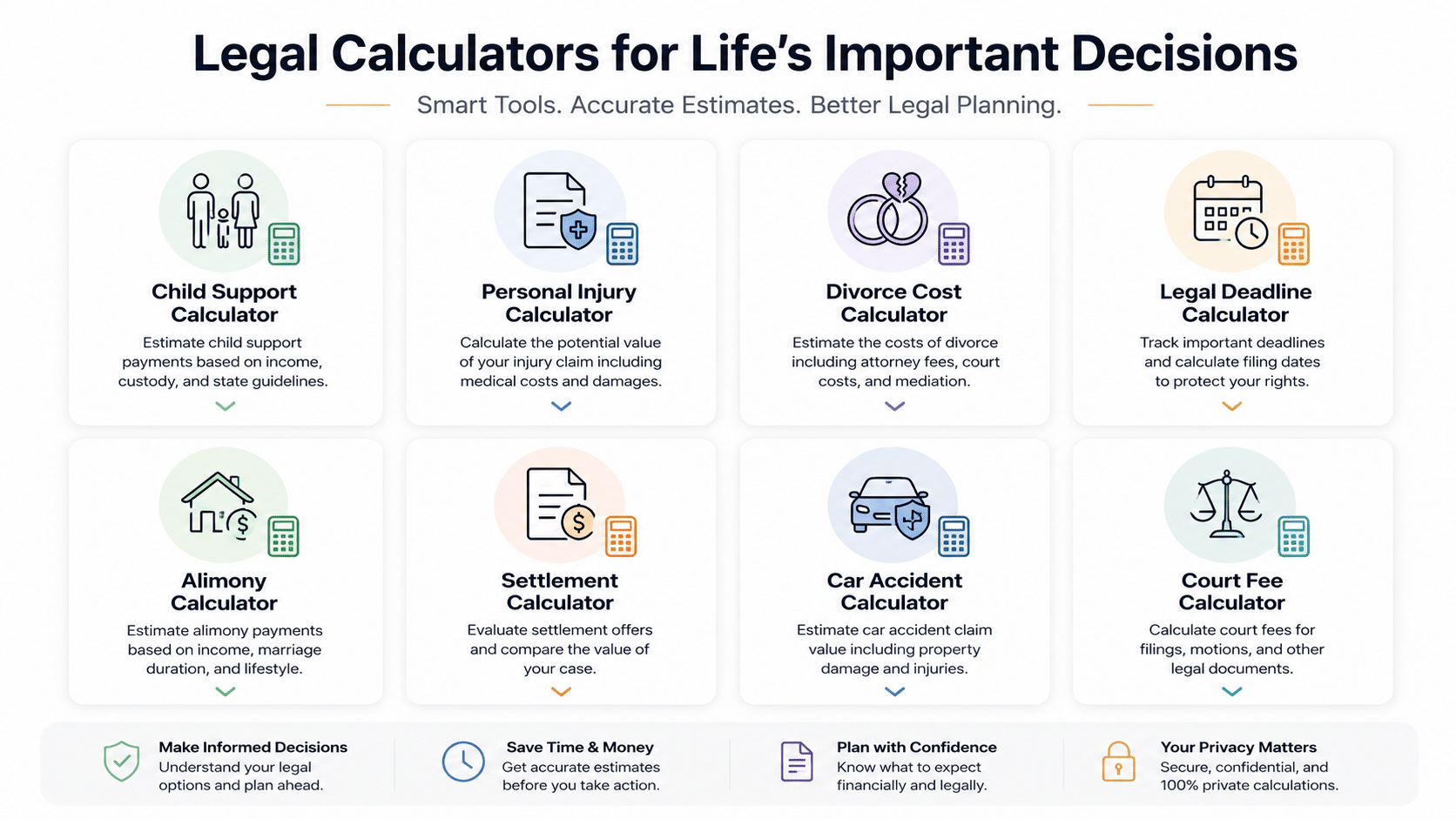
Here’s where it gets genuinely useful. “Legal calculator” is an umbrella term, and underneath that umbrella is a whole crowd of specialized tools. Let me introduce you to the ones you’re most likely to need — especially if you’re navigating family stuff.
1. Child Support Calculator
Easily the most-used calculator in this entire family. A child support calculator estimates how much one parent may owe the other to cover a child’s needs.
You’ll typically enter both parents’ incomes, how much time the child spends with each parent (parenting time or custody percentage), health insurance costs, daycare expenses, and your state. The tool then applies your state’s guideline formula.
Why is this one so popular? Because few questions are as emotionally loaded and as math-driven as “how much is child support going to be.” Parents on both sides want to know — the paying parent for budgeting, the receiving parent for planning. A child support calculator gives both of them a number before anyone sets foot in court.

2. Alimony / Spousal Support Calculator
When a marriage ends, sometimes one spouse pays the other for a period of time. That’s alimony, also called spousal support or maintenance. An alimony calculator estimates the amount and, in some cases, the duration.
Here’s the honest disclaimer: alimony is far less formula-driven than child support. Many states leave it largely to a judge’s discretion. So an alimony calculator gives you a rougher estimate — a starting point for conversation, not a prediction etched in stone. Still incredibly handy, but treat it with a bit more humility.

3. Divorce Cost Calculator
Divorce isn’t just emotionally expensive — it’s literally expensive. A divorce cost calculator estimates what the whole process might run you, factoring in attorney fees, court filing costs, mediation, whether it’s contested or uncontested, and your location.
I find this one quietly valuable. Nobody likes a financial surprise mid-crisis. Knowing whether you’re looking at a few hundred dollars or several thousand lets you plan instead of panic.

4. Personal Injury Settlement Calculator
Got hurt in a car accident, a slip-and-fall, or some other mishap that wasn’t your fault? A personal injury settlement calculator estimates what your claim might be worth.
These tools usually add up your medical bills, lost wages, and property damage, then apply a multiplier for pain and suffering. The result is a ballpark settlement range. It won’t capture every nuance of your case, but it gives you a reality check before an insurance adjuster lowballs you with a number that “sounds fine” only because you had nothing to compare it to.

5. Property Division Calculator
When couples split, so do the assets. A property division calculator helps you estimate how marital property — the house, savings, retirement accounts, that boat nobody uses — might be divided.
This depends heavily on whether you live in a community property state (assets generally split 50/50) or an equitable distribution state (assets split “fairly,” which isn’t always evenly). The calculator factors in your state’s approach to give you a clearer picture of what you might walk away with.

6. Child Custody / Parenting Time Calculator
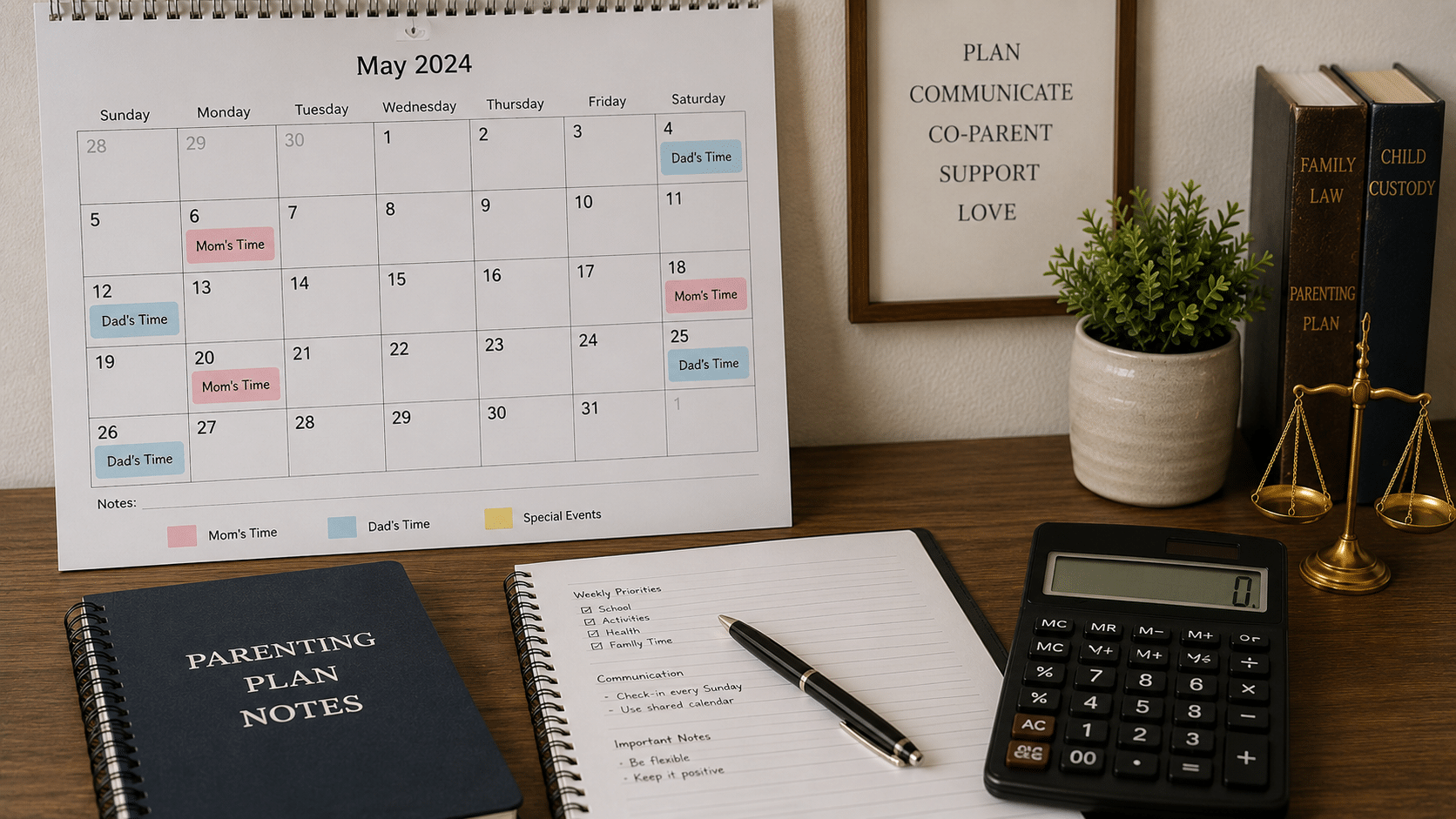
A parenting time calculator counts up exactly how many days, nights, or hours a child spends with each parent based on your custody schedule.
Sounds simple, but it’s sneaky-important. That percentage feeds directly into child support math, holiday planning, and even tax questions. Eyeballing it leads to arguments. Counting it precisely leads to clarity.
7. Back Pay / Lost Wages Calculator
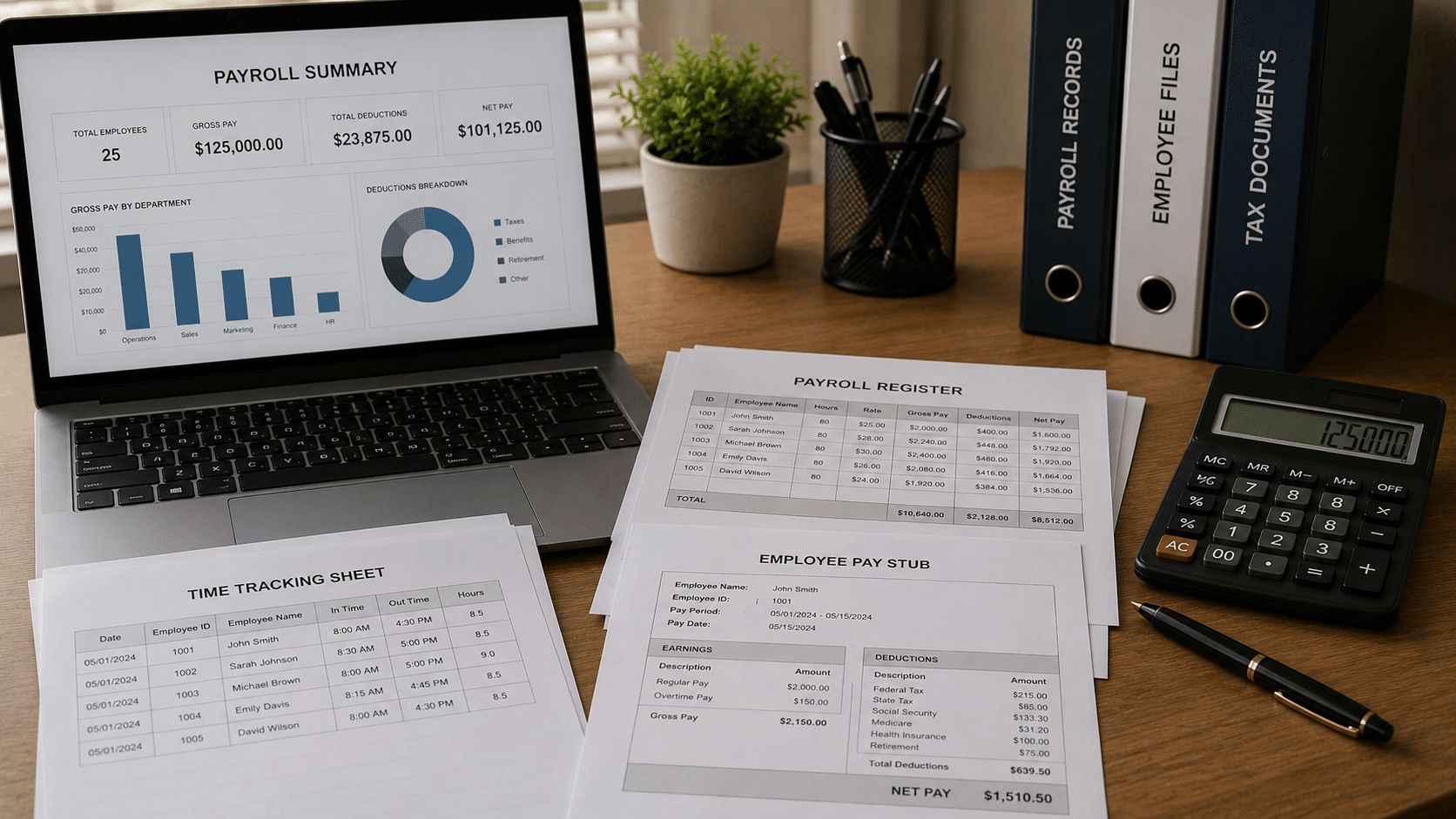
If you were wrongfully terminated, underpaid, or denied overtime, a back pay calculator estimates the wages you’re owed. Plug in your pay rate, hours, and the time period, and it tallies the gap.
8. Bankruptcy Means Test Calculator
Considering bankruptcy? A means test calculator helps you figure out whether you qualify for Chapter 7 by comparing your household income to your state’s median. It’s a gatekeeper tool — a quick “do I even qualify” check before you dive deeper.

9. Statute of Limitations Calculator
Every legal claim has an expiration date. Miss it, and you may lose your right to sue entirely. A statute of limitations calculator estimates your deadline based on the type of claim, the date it happened, and your state. Think of it as a legal egg timer — and not one you want to ignore.

10. Court Deadline / Date Calculator
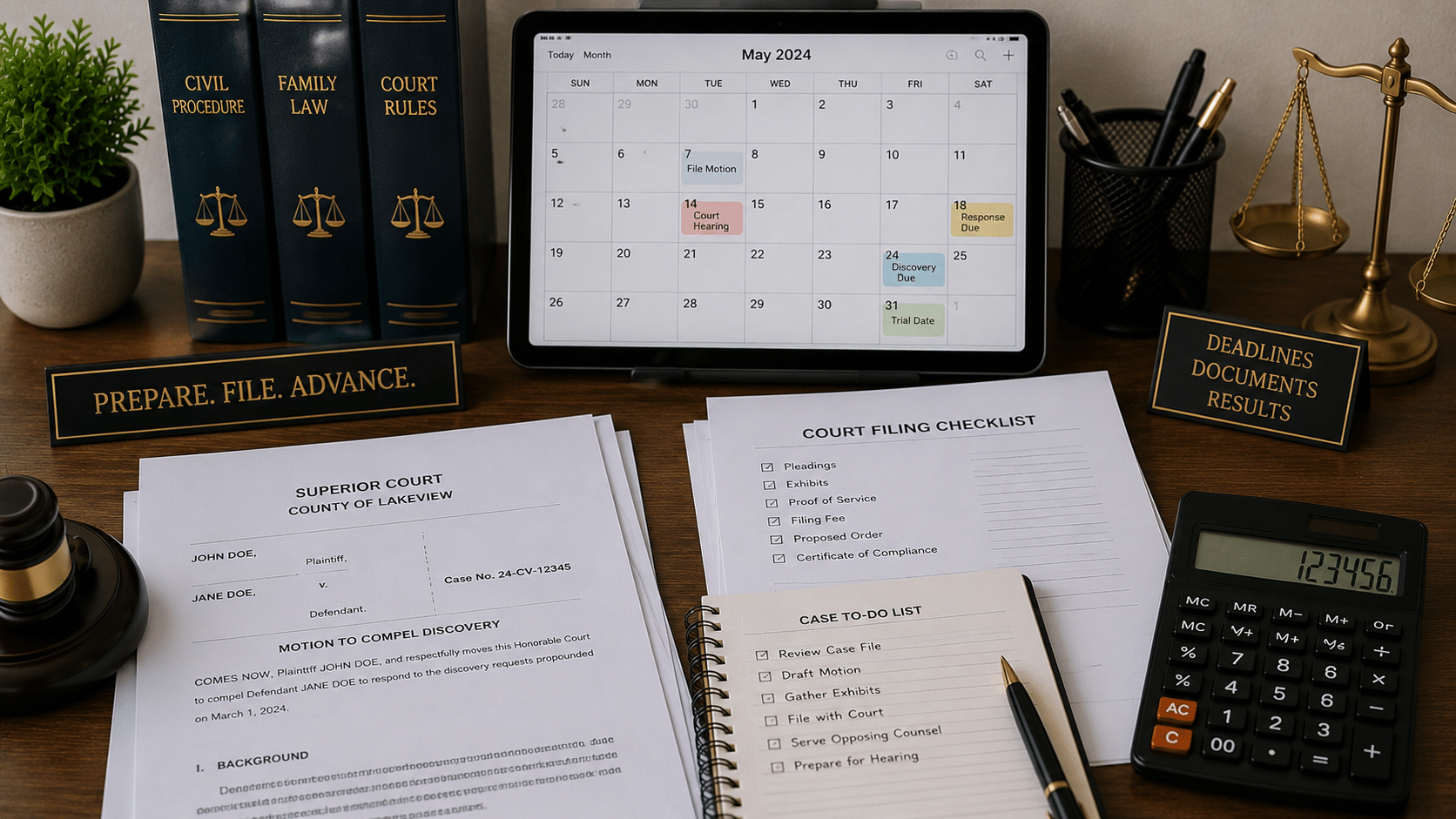
Courts run on deadlines, and they’re rarely forgiving. A court date calculator counts forward (or backward) from a key date to tell you when responses, filings, or appearances are due. Lawyers and paralegals lean on these constantly.
A Quick Comparison Table
Sometimes a table just says it better. Here’s a side-by-side look at the most common legal calculators:
| Calculator Type | What It Estimates | Who It’s Mainly For | How Reliable Is the Estimate? |
|---|---|---|---|
| Child Support | Monthly support amount | Divorced or separating parents | High — based on state formulas |
| Alimony / Spousal Support | Support amount & duration | Divorcing spouses | Moderate — judge has wide discretion |
| Divorce Cost | Total cost of divorce | Anyone considering divorce | Moderate — depends on case complexity |
| Personal Injury Settlement | Claim value range | Accident victims | Moderate — every injury case differs |
| Property Division | Asset split | Divorcing couples | Moderate — varies by state law |
| Parenting Time | Custody time percentage | Co-parents | High — it’s straightforward counting |
| Back Pay | Owed wages | Wronged employees | High — it’s mostly arithmetic |
| Bankruptcy Means Test | Chapter 7 eligibility | People facing debt | High — based on income medians |
| Statute of Limitations | Filing deadline | Anyone with a potential claim | High — but always verify with a lawyer |
Notice a pattern? The more a calculator relies on hard math and the less it relies on a judge’s personal call, the more you can trust the number.
So, What Is a Legal Calculator Actually Used For?
We’ve covered the types. Now let’s talk about the why — the real, everyday reasons people reach for these tools.
To Get a Reality Check Before the Drama Starts
This is the big one. Before you call a lawyer, before you confront an ex, before you accept an insurance offer — a legal calculator lets you peek at a likely outcome. It replaces dread with data. And data, even imperfect data, is a better companion than a 2 a.m. spiral of worst-case scenarios.
To Budget and Plan Your Life
If you’re the parent who’ll be paying child support, you need to know whether that’s $300 or $1,200 a month — because your rent, your groceries, and your sanity depend on it. If you’re the parent receiving it, you need to plan around it too. A calculator turns “unknown” into a line item you can actually build a budget around.
To Negotiate From a Position of Strength
Walking into a negotiation with no number is like showing up to a job interview not knowing what the job pays. You’ll take whatever you’re handed. A legal calculator arms you with a defensible figure. When the other side throws out a number, you can respond with, “Actually, the state guideline puts this closer to X.” That’s leverage. That’s confidence.
To Make Smarter Decisions About Whether to Even Proceed
Sometimes the calculator’s most valuable gift is a gentle “maybe don’t.” If a personal injury calculator suggests your claim is worth $800 and a lawsuit would cost you far more in time and stress, that’s useful intel. Knowing the size of the prize helps you decide whether the race is worth running.
To Speak Your Lawyer’s Language
When you arrive at a consultation already knowing the rough numbers, the conversation gets sharper and faster. You’re not paying premium hourly rates just to learn the basics — you’re using that time for strategy. Calculators make your lawyer’s job easier and cheaper for you. Everybody wins.

Who Actually Uses Legal Calculators?
Short answer: way more people than you’d think. Here’s the crowd:
- Parents — divorced, separated, or never married — checking child support and parenting time.
- Divorcing spouses sizing up alimony, property division, and total costs.
- Married couples quietly planning, or doing prenup math, or just stress-testing a “what if.”
- Adoptive parents estimating costs and navigating support questions.
- Accident victims figuring out what a fair settlement looks like.
- Employees calculating back pay or unpaid overtime.
- People facing debt running the bankruptcy means test.
- Lawyers, paralegals, and mediators who use them daily to give clients fast estimates.
Notice that last group. Even professionals use legal calculators. That should tell you something — these tools aren’t a shortcut for the uninformed. They’re a standard part of how legal estimating gets done.
The Real Benefits of Using a Legal Calculator
Let me lay out, plainly, why these tools are worth your time.
- They’re fast. A number in two minutes versus a week of waiting for a callback.
- They’re usually free. Most quality legal calculators cost nothing to use.
- They’re private. You can explore a sensitive question alone, at midnight, without explaining yourself to anyone.
- They reduce anxiety. Uncertainty is the real monster. A calculator switches the lights on.
- They educate you. Use one and you’ll understand what drives your case — the inputs that matter most.
- They save money. Less guessing means fewer billable hours spent on basics.
- They level the playing field. You don’t need a law degree to get a credible starting point anymore.
That last benefit is the one I love most. Legal stuff used to feel like a locked room only the experts could enter. Calculators handed regular people a key. Not the whole house — just a key to the first room. But that first room is where the panic usually lives, and getting out of it changes everything.
The Honest Limitations (Because Trust Matters)
I’d be doing you a disservice if I only sang the praises. So here’s the straight talk.
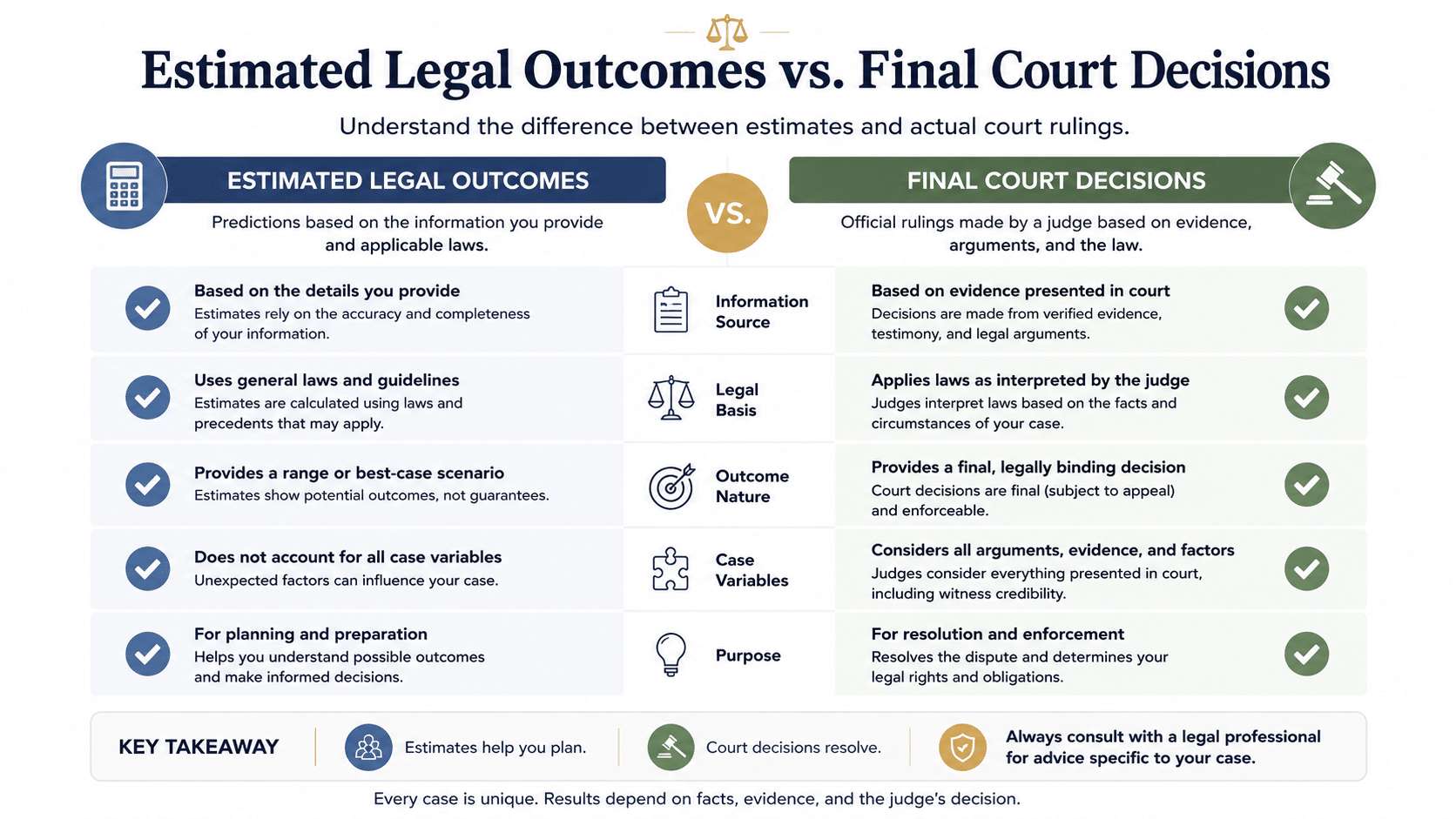
A legal calculator is an estimate, not a verdict. Repeat that to yourself. It is not a binding legal result. A judge can — and often will — land somewhere different.
It can’t see the whole picture. Calculators handle numbers. They can’t weigh that your ex hid income, that there’s a history of domestic issues, that a child has special medical needs, or a hundred other human factors that move a real case. Life is messier than any input field.
Laws change, and they vary wildly by state. What’s true in Texas isn’t true in New York. A good calculator updates for this; a stale one doesn’t. Always confirm the tool reflects current law in your state.
Bad inputs ruin everything. If you fudge your income or guess at the parenting schedule, the output is fiction. The calculator can only be as honest as you are.
It is not legal advice. I’ll say it loud for the people in the back: a legal calculator does not replace a lawyer. It’s a flashlight, not a guide. Use it to prepare, then bring a real attorney in to navigate.
Here’s how I think about it. A legal calculator is like checking the weather before a trip. The forecast helps you pack. But you still don’t control the sky — and you definitely still want a good pilot.
How to Use a Legal Calculator the Right Way
Want results you can actually trust? Follow these steps.
- Pick the right calculator for your situation. Don’t use an alimony tool for a child support question. Match the tool to the job.
- Confirm it’s built for your state. Legal math is local. A national “average” calculator is far less useful than a state-specific one.
- Gather accurate documents first. Pay stubs, tax returns, expense records, accident bills, dates. Get them in front of you before you start typing.
- Enter real numbers, not hopeful ones. Wishful thinking produces wishful results. Be honest, even when it stings.
- Read the breakdown, not just the headline number. Understand why you got that result. That understanding is half the value.
- Run a few scenarios. Change one input — say, parenting time — and watch how the number shifts. It teaches you what really moves the needle.
- Treat the result as a starting point. Take it to a lawyer, a mediator, or the negotiation table — as a conversation opener, not a final answer.
Do all that, and you’ll get the most out of these tools without falling into the trap of over-trusting them.
Where Can You Find Reliable Legal Calculators?
Not all calculators are created equal. The internet is full of flashy tools with no formula behind them. Look for ones that are state-specific, transparent about their math, clearly labeled as estimates, and kept up to date.
If you want a solid starting point, you can explore a full collection of legal calculators over at USLawFAQ’s calculator hub. It gathers a range of family-law and general legal calculators in one place, which beats hunting through a dozen sketchy sites with mystery math.
Frequently Asked Questions About Legal Calculators
Are legal calculators accurate?
They’re as accurate as the formula behind them and the information you feed in. Calculators based on hard state guidelines — like child support — tend to be quite reliable. Ones dealing with discretionary areas — like alimony — are rougher. Either way, treat every result as an estimate, never a guarantee.
Are legal calculators free?
Most reputable ones are, yes. You can run the numbers on child support, divorce costs, or a settlement estimate without spending a dime. Be a little cautious of tools that demand payment before showing you anything.
Can I use a legal calculator instead of hiring a lawyer?
No — and please don’t try. A calculator is a preparation tool. It helps you understand your situation and walk into a lawyer’s office informed. But it can’t represent you, file your paperwork, or argue your case. Use it with legal help, not instead of it.
Is a legal calculator result legally binding?
Not at all. The number is an estimate. The actual, binding figure comes from a settlement agreement, a mediation outcome, or a judge’s order. A calculator has no legal authority whatsoever.
Do legal calculators work in every state?
The good ones are built state by state, because the law differs everywhere. Always make sure the calculator you’re using reflects your state’s current rules. A generic, one-size-fits-all tool will give you a much fuzzier number.
What information do I need to use one?
It depends on the calculator, but commonly: your income (and sometimes the other party’s), your state, the number of children, custody or parenting-time details, relevant expenses, and key dates. Gather your documents first so you’re entering facts, not guesses.
Are online legal calculators safe to use?
Most are, especially the ones that don’t ask you to create an account or hand over identifying details. Many run entirely in your browser. Still, use common sense — stick to reputable sites and avoid entering Social Security numbers or sensitive ID info into a random tool.
How accurate is a child support calculator specifically?
Usually quite accurate, because most states publish a clear formula and the calculator mirrors it. That said, judges can deviate from the guideline for special circumstances, so consider the result a strong estimate rather than a locked-in number.
The Bottom Line
So — what is a legal calculator, and what is it used for?
It’s a free, fast, surprisingly empowering online tool that takes the facts of your situation and hands you an educated estimate of a legal number: child support, alimony, a settlement, a deadline, a cost. It’s used to plan, to budget, to negotiate, to decide, and to walk into a lawyer’s office already knowing the basics.
What it isn’t is a substitute for real legal advice, a crystal ball, or a binding verdict. It’s a flashlight in a dark room — and when you’re going through a divorce, a custody fight, an injury claim, or a debt crisis, that little beam of light can be the difference between panic and a plan.
Here’s my parting advice. Don’t let uncertainty run your life when a two-minute tool can shrink it. Go run the numbers for whatever’s been keeping you up at night. Get your estimate. Understand what’s driving it. Then take that knowledge to a qualified attorney and move forward with your shoulders a little lower and your head a little clearer.
Ready to stop guessing? Head over to the USLawFAQ calculator hub, pick the calculator that fits your situation, and get your number today. Your future self — the one who actually knows what they’re walking into — will thank you.

Disclaimer: This article is for general informational purposes only and does not constitute legal advice. Legal calculators provide estimates, not guaranteed outcomes. Laws vary by state and change over time. For advice specific to your situation, please consult a licensed attorney in your state.